Best Value

from$99/mo
SemaglutideRx
GLP-1 Receptor Agonist
SemaglutideRx
GLP-1 Receptor Agonist
TirzepatideRx
Dual GLP-1 + GIP Receptor Agonist

Semaglutide ODT PillsRx
GLP-1 Receptor Agonist - Oral Dissolving Tablet

Tirzepatide ODT PillsRx
Dual GLP-1 + GIP Receptor Agonist - Oral Dissolving Tablet

Men's Complete Hair Growth PillRx
Minoxidil, Finasteride, Biotin
Men's Advanced Hair SprayRx
Minoxidil, Finasteride, Fluocinolone, Tretinoin
Women's Premium Hair SprayRx
Minoxidil, Tretinoin, Fluocinolone, Biotin, Melatonin
Women's Complete Hair Growth PillRx
Minoxidil, Vitamin E, Biotin
Written by Luma Meds Team
August 8, 2026 · 9 min read
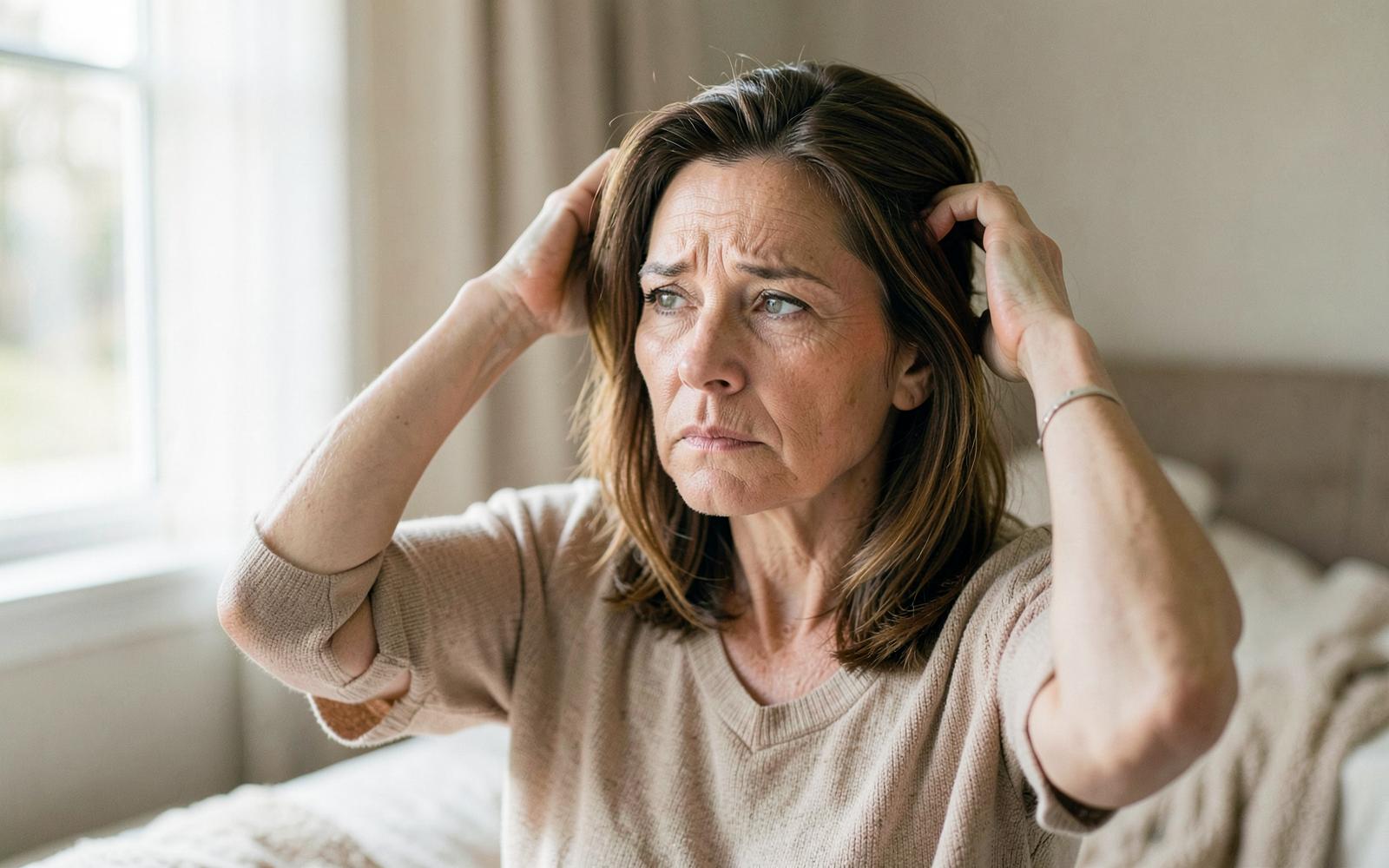
Hot flashes and changes in sleep may be well-known signs of menopause. Hair thinning can be another.
Some women first notice their part getting wider. Others notice their ponytail becoming smaller, more hair in the shower, or that their hair simply doesn't feel as thick as it used to.
These changes aren't necessarily your imagination.
Hormonal changes during perimenopause and menopause can affect the hair follicle and the normal hair-growth cycle. At the same time, age, genetics, nutrition, stress, and certain medical conditions can contribute to thinning hair.
The good news is that menopause-related hair thinning doesn't necessarily mean you have to accept continued hair loss.
One of the biggest hormonal changes during menopause is a decline in estrogen. Hair follicles are sensitive to hormones, including estrogen, and research suggests that estrogen influences several aspects of hair biology, including the hair-growth cycle.
As estrogen levels decline around menopause, women may experience changes such as:
Menopause isn't necessarily the only cause. Instead, hormonal changes can occur at the same time that age-related and genetic hair thinning becomes more noticeable.
Women don't usually experience the same pattern of baldness commonly seen in men. One of the most common forms is female pattern hair loss (FPHL).
Instead of developing a completely bald area, women may notice gradual thinning across the top and center of the scalp. Common signs include:
The frontal hairline is often relatively preserved. Female pattern hair loss becomes more common with age, which is one reason it can become particularly noticeable during or after menopause.
No. Menopause and estrogen changes are only part of the picture. Hair growth is influenced by a complicated combination of:
Changes in estrogen and the relative balance between estrogen and androgens may influence the hair follicle.
A family history of thinning hair can increase the likelihood of developing female pattern hair loss.
Hair follicles naturally change with age, and individual strands may become finer.
Iron deficiency, inadequate protein intake, and certain nutritional deficiencies can contribute to hair shedding.
Significant physical or emotional stress can trigger a temporary form of shedding known as telogen effluvium.
Thyroid disorders, anemia, autoimmune conditions, and other health problems can sometimes cause or worsen hair loss.
That's why not every woman experiencing hair loss around menopause should automatically assume estrogen is responsible.
Women may also notice that their hair itself feels different. Hair may become:
Research examining menopause and hair biology suggests that hormonal changes can affect both the hair cycle and characteristics of the hair shaft. So even without dramatic shedding, someone's hair may look or feel noticeably thinner than it did several years earlier.
It depends on the cause.
Some types of shedding can improve once the underlying trigger is corrected. For example, telogen effluvium caused by illness, major stress, rapid weight loss, or nutritional deficiency may improve over time.
Female pattern hair loss is different. FPHL involves progressive miniaturization of hair follicles, meaning follicles gradually produce thinner and shorter hairs. Without treatment, it can continue progressing.
Why early evaluation matters
Why early evaluation matters
Hair-loss treatments are generally better at preserving and strengthening existing hair than restoring follicles after significant thinning has occurred.
For women with female pattern hair loss, minoxidil is one of the best-studied treatment options.
Minoxidil can help extend the growth phase of the hair cycle and encourage miniaturized follicles to produce thicker hairs. Large reviews of clinical trials have found that women treated with topical minoxidil were more likely to experience meaningful hair regrowth than women receiving placebo.
Importantly, research suggests minoxidil can work in both premenopausal and postmenopausal women.
Hair growth takes time, however. Treatment typically needs to be used consistently for several months before meaningful changes in density can be evaluated.
Minoxidil isn't the only treatment that may be considered. Depending on the type of hair loss, medical history, age, symptoms, and other factors, a healthcare provider may consider treatments such as:
Some of these medications are used off-label for female hair loss. There isn't one universal treatment that is appropriate for every woman, particularly because menopausal hair thinning can have several different causes. A medical evaluation can help determine which approach makes sense.
Women's Hair
Complete a quick online visit and a licensed provider can review your hair-loss pattern and determine whether a prescription treatment may be appropriate for you.
Start your hair visitThis is an area where it's easy to oversimplify.
Because estrogen declines during menopause and hair follicles respond to estrogen, it might seem logical that estrogen replacement would automatically reverse hair thinning. The evidence isn't that straightforward.
Researchers continue to investigate the relationship between estrogen, menopausal hormone therapy, and hair loss, but hormone replacement therapy isn't currently considered a standard stand-alone treatment for female pattern hair loss. A recent systematic review specifically examining estrogen therapy for menopausal hair loss highlights the continued interest in this relationship, but the evidence remains limited.
Hormone therapy should therefore be considered based on a woman's broader menopausal symptoms, health history, risks, and benefits — not simply as a hair-growth treatment.
Hair follicles are metabolically active and require adequate nutrition. Women experiencing hair thinning should avoid assuming that taking large amounts of hair vitamins will automatically solve the problem. Instead, it may be more useful to make sure you're getting enough:
Supplementation is most useful when an actual deficiency or inadequate intake exists. If hair loss is significant, a healthcare provider may recommend laboratory testing depending on symptoms and medical history.
Gradual thinning along the top of the scalp is common with female pattern hair loss. But certain changes deserve closer evaluation. Talk with a healthcare provider if you experience:
These patterns may indicate something other than typical female pattern hair loss. For example, frontal fibrosing alopecia, a form of scarring hair loss, occurs particularly in postmenopausal women and benefits from early recognition.
Hair thinning is common during and after menopause, and hormonal changes may be one contributor. Declining estrogen and changes in the hormonal environment can influence hair follicles, while aging, genetics, nutrition, stress, and medical conditions can also play a role.
For many women, the result is gradual thinning across the top of the scalp, a widening part, finer hair, or reduced overall density.
The important thing is recognizing that hair loss isn't necessarily something you simply have to accept as part of menopause. Female pattern hair loss has treatment options, and minoxidil remains one of the most well-supported treatments for women, including postmenopausal women.
The earlier progressive hair thinning is recognized, the better the opportunity may be to preserve existing hair and support healthier growth.
At Luma Meds, eligible patients can discuss their hair-loss concerns and available treatment options with a licensed healthcare provider to determine an approach that may be appropriate for their individual needs.
This article is for educational purposes only and is not intended to provide medical advice, diagnosis, or treatment. Individual treatment decisions should be made with a licensed healthcare provider.
Share this article