Best Value
from$99/mo
SemaglutideRx
GLP-1 Receptor Agonist
SemaglutideRx
GLP-1 Receptor Agonist
TirzepatideRx
Dual GLP-1 + GIP Receptor Agonist

Semaglutide ODT PillsRx
GLP-1 Receptor Agonist - Oral Dissolving Tablet
Tirzepatide ODT PillsRx
Dual GLP-1 + GIP Receptor Agonist - Oral Dissolving Tablet
Men's Complete Hair Growth PillRx
Minoxidil, Finasteride, Biotin

Men's Advanced Hair SprayRx
Minoxidil, Finasteride, Fluocinolone, Tretinoin

Women's Premium Hair SprayRx
Minoxidil, Tretinoin, Fluocinolone, Biotin, Melatonin

Women's Complete Hair Growth PillRx
Minoxidil, Vitamin E, Biotin
Written by Luma Meds Team
July 10, 2026 · 10 min read

If lipotropic injections are supposed to support metabolism, do they actually do anything — or are they just another wellness trend?
It's a fair question.
Lipotropic injections such as MIC + B12 have become popular among people who are already working on their weight: improving their diet, exercising more, or following a medically supervised weight-management plan.
And the reason they're interesting isn't because they contain some secret “fat-burning” drug. They don't.
Instead, they combine nutrients that already play roles in:
So the better question isn't “Will this injection make me lose weight?” It's “Can these nutrients support the metabolic systems I'm already relying on while I work toward my goals?”
That's where the science becomes much more useful.
This is important, because expectations around lipotropic injections can get unrealistic.
If someone tells you “this shot melts fat,” that's not an accurate way to describe it.
MIC + B12 isn't a GLP-1 medication. It doesn't directly suppress appetite. And it hasn't been shown to independently produce the kind of weight loss seen with medications specifically developed and studied for obesity.
Instead, lipotropic injections are used as supportive wellness treatments.
Think about someone who's already:
MIC + B12 provides several nutrients involved in the metabolic machinery working underneath those efforts. That's the role it makes the most sense to evaluate.
Methionine, inositol, and choline each play different roles in normal metabolism, which helps explain why they're included in lipotropic formulas.
The takeaway: MIC ingredients support real metabolic processes, but they are not stand-alone fat-loss drugs.
B12 is probably the reason many patients become interested in these injections in the first place. People associate B12 with one thing: energy. And there's real biology behind that association.
Your body needs vitamin B12 for normal:
When someone is B12 deficient, fatigue and weakness can occur. Correcting a deficiency can therefore make a noticeable difference in how someone feels.
But here's what B12 doesn't do: it doesn't act like caffeine. Someone with perfectly adequate B12 levels isn't guaranteed to feel dramatically more energetic just because they receive extra B12.
That's why the most accurate way to describe it is: B12 supports the metabolic systems your body uses to produce and utilize energy.
Interestingly, modern research suggests both routes can be effective.
A 2025 systematic review and meta-analysis evaluated 16 studies involving more than 6,000 participants and compared oral, sublingual, and intramuscular B12. All three approaches significantly increased B12 levels, and researchers didn't find a statistically significant overall difference between the routes for the major outcomes they evaluated.
So why use an injection? Because an injection:
For someone already comfortable with injectable wellness treatments, that can make MIC + B12 easy to incorporate into a routine.
Let's make this one very clear.
There is not strong evidence showing that MIC + B12 injections themselves directly cause significant body-fat loss.
That's different from saying “the ingredients don't do anything.” They do. The distinction is important.
Methionine, inositol, choline, and B12 all participate in legitimate biological processes. What hasn't been demonstrated in strong randomized clinical trials is that putting them together in a lipotropic injection suddenly turns them into a powerful stand-alone weight-loss medication.
And that's okay — because that isn't necessarily where Lipo-B fits best.
Imagine you're trying to improve your fitness.
But none of those things replaces the workout.
Lipotropic injections fit into weight management in a similar way. Your nutrition matters. Your activity matters. Your treatment plan matters. Your consistency matters.
MIC + B12 can then sit alongside those things as additional metabolic and nutritional support. That's a far more realistic way to think about the treatment.
The term sounds like it should mean “burns fat.” It doesn't.
Lipotropic compounds are generally substances involved in fat metabolism, transport, or movement — particularly in the liver. Research reviews have identified compounds such as choline, methionine, inositol, and carnitine as lipotropic nutrients because of their relationships with hepatic lipid metabolism.
However, researchers have also noted that direct human intervention studies evaluating “lipotropic” effects as a category are limited.
So: lipotropic ≠ automatic weight loss. It means the ingredients participate in processes involving lipid metabolism. That's the scientifically accurate — and still useful — definition.
Because losing weight puts a lot of attention on what you're taking away. Fewer calories. Less snacking. Smaller portions.
But good weight management should also consider what you're supporting. People trying to lose weight still need appropriate:
That's one reason lipotropic injections have become popular as companion treatments. For someone already following a weight-management strategy, MIC + B12 offers a way to add several nutrients involved in metabolic processes into one routine.
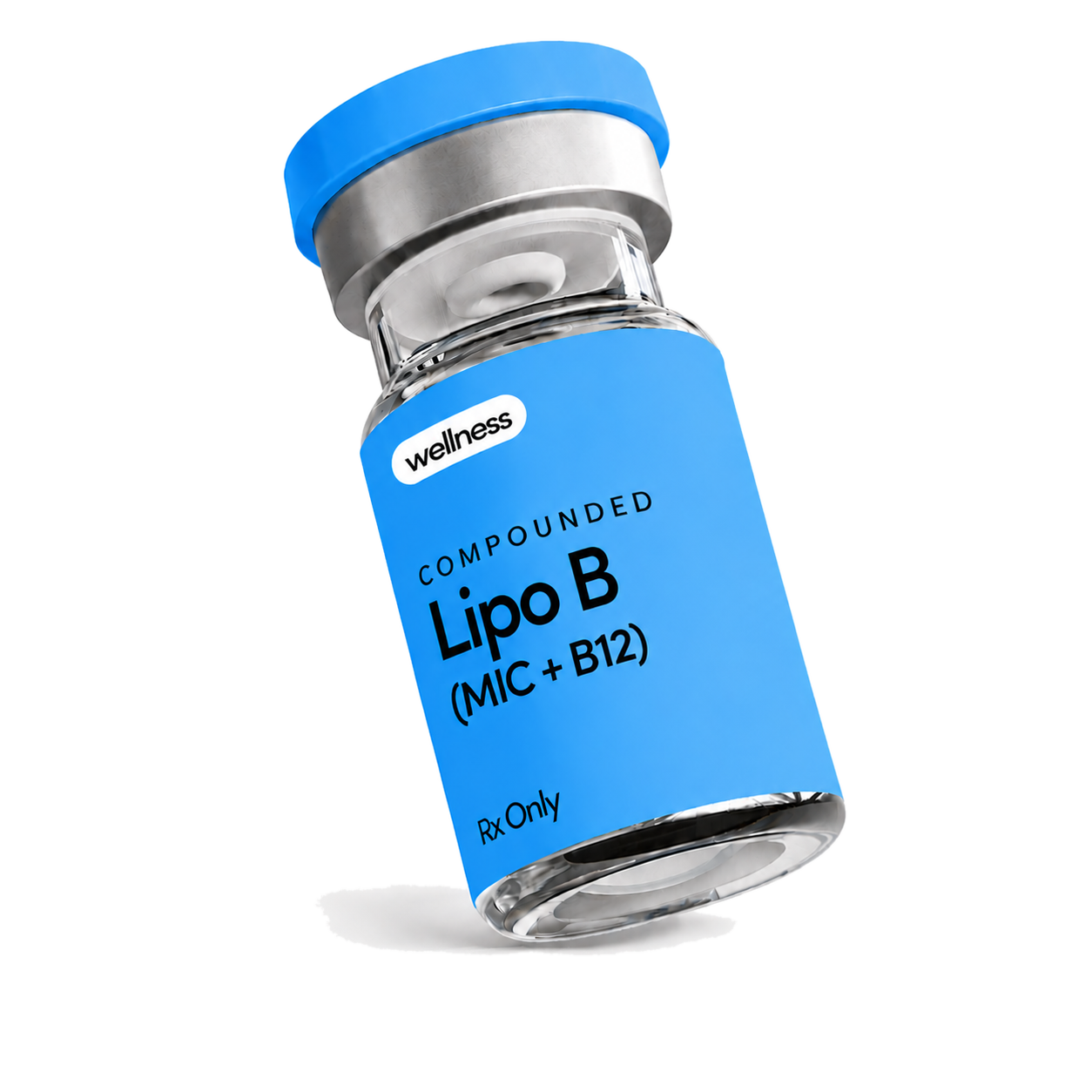
Lipo-B (MIC + B12)
Complete a short online visit. If Lipo-B is appropriate for you, a licensed provider prescribes it and your MIC + B12 injections ship straight to your door.
Start your online visitPotentially — but this depends heavily on the individual.
If someone has low B12 status, correcting it may improve fatigue associated with the deficiency. If someone already has adequate B12 levels, the effect may be much less noticeable.
And remember: fatigue during weight loss can have many causes.
So a Lipo-B injection shouldn't become the answer to every low-energy day.
Pro tip
Pro tip
If you're constantly exhausted during a weight-loss program, don't simply keep adding “energy” supplements.
It may be worth reviewing your nutrition, calorie intake, hydration, sleep, medications, and health history with your healthcare provider.
Here's the simple version.
| Claim | What we know |
|---|---|
| B12 supports normal energy metabolism | Yes |
| Choline plays a role in lipid transport and liver function | Yes |
| Methionine participates in normal metabolic pathways | Yes |
| Inositol has been studied for metabolic health | Yes |
| Some inositol trials show modest BMI improvements | Yes, in certain populations |
| MIC ingredients have real biological roles | Yes |
| MIC + B12 alone causes major weight loss | Not established |
| Lipotropic injections can complement a broader wellness plan | That's the more appropriate way to view them |
Because not every wellness treatment needs to do everything by itself.
If someone is already:
…they may want additional support that fits into the same routine. MIC + B12 combines several familiar nutrients into one treatment, and for patients who prefer an injectable approach, that can be attractive.
It's not replacing the plan. It's adding to it.
This is probably the most important expectation to set.
These treatments aren't competitors.
GLP-1-based medications such as semaglutide and tirzepatide have extensive clinical evidence showing significant effects on body weight in appropriate patients. MIC + B12 does not have that kind of weight-loss evidence.
But they also work through completely different mechanisms.
So for an appropriate patient, the conversation may not be “Which one should I choose?” It may be “What should my overall weight-management plan look like?” And that's where supportive treatments can make more sense.
They can do what their ingredients are biologically designed to do.
What hasn't been established is that combining these nutrients into a MIC + B12 injection creates a stand-alone fat-loss treatment.
That's why we think the most useful way to view Lipo-B is as metabolic support for someone already working toward their goals. Not a shortcut. Not a replacement for the fundamentals. And not a competitor to evidence-based weight-loss treatment.
If you're asking, “Will a lipotropic injection make the pounds fall off while I change nothing else?” — the answer is no.
But if you're asking, “Are the ingredients involved in real metabolic processes, and could this fit into a larger wellness or weight-management plan?” — that's a much more reasonable conversation.
MIC + B12 brings together several nutrients with established biological roles involving:
For someone already investing in their nutrition, activity, weight management, and overall wellness, that's what can make Lipo-B an appealing supportive addition to the bigger plan.
Your progress still comes from the plan. Lipo-B is there to support what you're already building.
This article is for educational purposes only and is not intended to provide medical advice, diagnosis, or treatment. Individual treatment decisions should be made with a licensed healthcare provider.
Clinical evidence supporting MIC + B12 injections as a stand-alone treatment for weight loss is limited. Individual responses vary, and injectable treatments should be used only when appropriate and under the direction of a qualified healthcare provider.
Share this article