Best Value

from$99/mo
SemaglutideRx
GLP-1 Receptor Agonist
SemaglutideRx
GLP-1 Receptor Agonist
TirzepatideRx
Dual GLP-1 + GIP Receptor Agonist

Semaglutide ODT PillsRx
GLP-1 Receptor Agonist - Oral Dissolving Tablet
Tirzepatide ODT PillsRx
Dual GLP-1 + GIP Receptor Agonist - Oral Dissolving Tablet

Men's Complete Hair Growth PillRx
Minoxidil, Finasteride, Biotin

Men's Advanced Hair SprayRx
Minoxidil, Finasteride, Fluocinolone, Tretinoin

Women's Premium Hair SprayRx
Minoxidil, Tretinoin, Fluocinolone, Biotin, Melatonin

Women's Complete Hair Growth PillRx
Minoxidil, Vitamin E, Biotin
Written by Luma Meds Team
July 27, 2026 · 7 min read

If you're already taking a GLP-1, where does Lipo-B fit into the picture?
The simplest answer is:
They serve different roles.
GLP-1 medications such as semaglutide and tirzepatide are used for medical weight management.
Lipo-B, usually a MIC + B12 formulation, may be added as a supportive treatment during that process.
It isn't there to replace the GLP-1 or make the medication “stronger.”
Instead, the two may be used together as part of a broader weight-management plan.
GLP-1 treatment often leads to a noticeable reduction in appetite.
That can make calorie reduction much easier — but it can also mean someone is simply eating less overall.
As food intake drops, patients may need to pay more attention to:
This is where supportive treatments like Lipo-B may come into the conversation.
The GLP-1 targets appetite and weight management. Lipo-B may be used to support normal metabolic and nutritional processes during the journey.
A useful way to think about the combination is:
| GLP-1 (semaglutide / tirzepatide) | Lipo-B (MIC + B12) |
|---|---|
| Helps manage: hunger, satiety, food intake, and weight reduction | May be used as: nutritional support, metabolic support, and B12 support — depending on the formulation and the patient's individual needs |
They aren't competing treatments. They're complementary in the sense that they address different parts of the same overall program.
Sometimes patients report feeling more tired when starting or increasing a GLP-1.
That doesn't automatically mean they need Lipo-B.
Fatigue can come from many things, including:
If B12 status is low or nutritional intake has dropped substantially, a provider may decide that supportive supplementation is worth discussing.
Not an automatic fix
Not an automatic fix
Lipo-B shouldn't be thought of as “the fix for GLP-1 fatigue.” The cause of the fatigue still matters — fewer calories, low protein, dehydration, and poor sleep are far more common culprits.
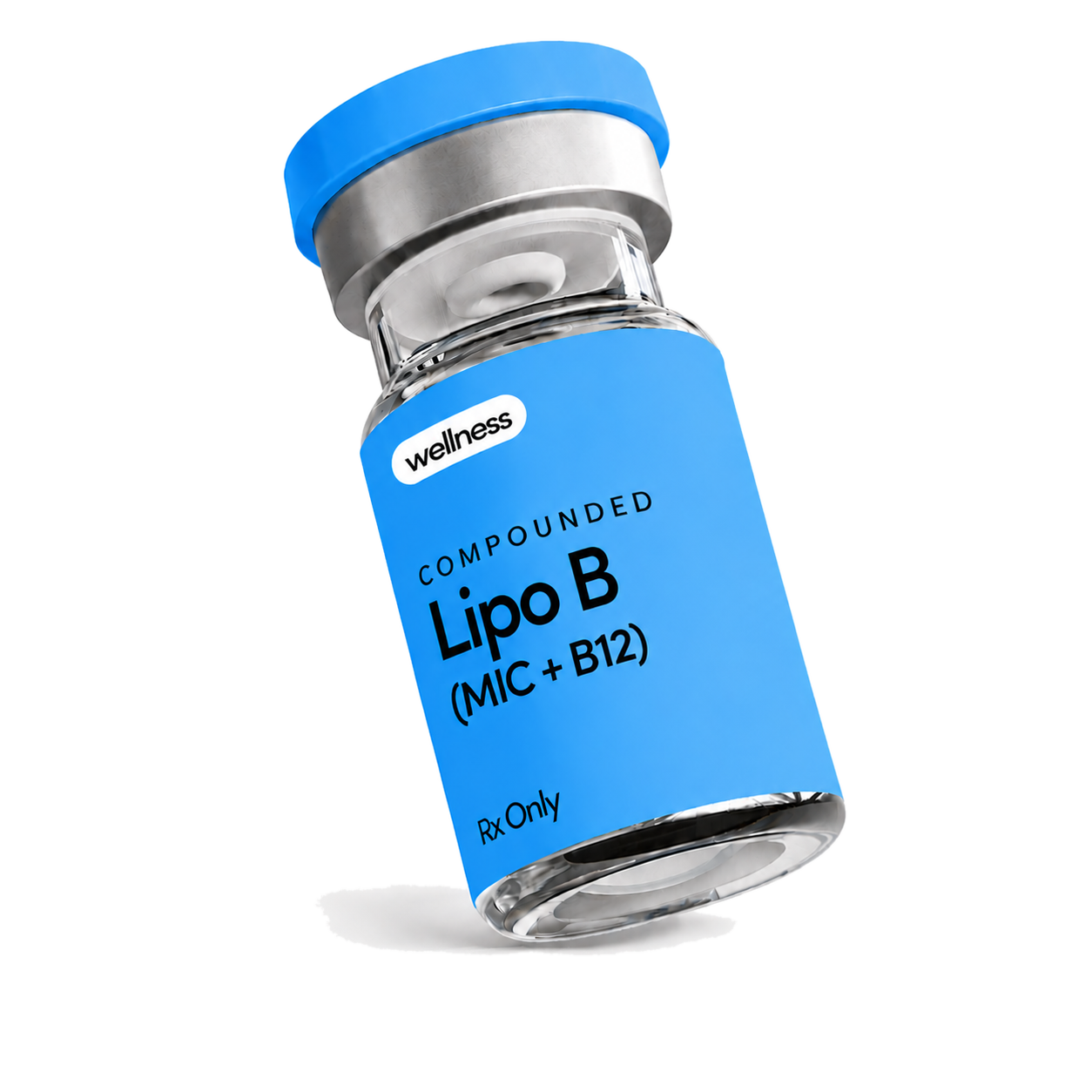
Lipo-B (MIC + B12)
Complete a short online visit. If Lipo-B is appropriate for you, a licensed provider prescribes it and your MIC + B12 injections ship straight to your door.
Start your online visitNot based on current evidence.
There isn't strong clinical evidence showing that adding MIC+B12 to semaglutide or tirzepatide reliably increases the amount of weight someone will lose.
So this shouldn't be viewed as: GLP-1 + Lipo-B = extra fat loss.
A better way to think about it is:
A provider may consider both treatments when a patient:
Not every patient needs it. And adding more treatments simply for the sake of adding more treatments isn't necessarily better.
Even if someone is using Lipo-B, the fundamentals still matter more.
It doesn't replace:
If GLP-1 treatment dramatically reduces appetite, the goal shouldn't just be: eat as little as possible.
It should be: make the food you are eating count.
Potentially, if both are part of the treatment plan recommended by the healthcare provider.
They have different ingredients and different purposes.
That said, injectable medications should not be mixed together in the same syringe unless specifically directed by the prescribing clinician and product instructions.
Lipo-B and GLP-1 medications may be used together because they address different parts of a weight-management plan.
The GLP-1 is the evidence-based medication targeting appetite, satiety, and weight reduction.
Lipo-B may be added as supportive nutritional or metabolic therapy depending on the patient's needs.
The key distinction is:
Lipo-B doesn't make the GLP-1 work harder. It may simply help support the patient while the GLP-1 is doing its job.
For someone eating significantly less, that can mean paying closer attention to nutrition, hydration, protein, and nutrient status — and deciding with a healthcare provider whether additional support makes sense.
This article is for educational purposes only and is not intended to provide medical advice, diagnosis, or treatment. Individual treatment decisions should be made with a licensed healthcare provider.
Share this article